
Table of Contents
ToggleAlternate Nostril Breathing Benefits for Stress Relief
Alternate nostril breathing is a yogic breathing technique that involves breathing through one nostril at a time in a specific pattern. It may help reduce feelings of stress, improve focus, support emotional balance, and activate the body’s relaxation response. In Ayurveda, it is used to balance energy flow, while modern research suggests it may positively influence nervous system regulation and stress resilience.
Have You Ever Felt "Tired but Wired"?
Your body is exhausted.
But your mind refuses to stop.
You lie in bed replaying conversations. Thinking about work. Worrying about family. Planning tomorrow before today is even finished.
The strange part?
You may not even realize you’re stressed anymore.
For many adults over 40, stress doesn’t always feel dramatic. It shows up quietly.
A shorter temper.
Poor sleep.
Brain fog.
Digestive discomfort.
A feeling that your nervous system is constantly running in the background.
This is exactly where alternate nostril breathing benefits become so valuable.
Unlike many wellness practices that demand major lifestyle changes, this ancient Ayurvedic breathing technique can be practiced almost anywhere—in your car before work, at your desk, before bed, or during a stressful afternoon.
And the goal isn’t simply relaxation.
The deeper purpose is balance.
Balance between activity and rest.
Between thinking and feeling.
Between doing and being.
In Ayurveda, this practice is known as Nadi Shodhana, which translates roughly to “channel cleansing.” While that may sound mystical, the practical effect is surprisingly modern: helping calm an overstimulated nervous system.
- Alternate nostril breathing is one of the safest beginner-friendly breathwork practices for stress relief.
- Nadi Shodhana may help shift the body from a stress response toward a relaxation response.
- Consistent practice often matters more than long practice sessions.
- Many people notice benefits within days, especially improved calmness and mental clarity.
- The technique connects naturally with Sleep Wellness, Mindful Living, and Emotional Wellbeing.
- Ayurveda views the practice as balancing opposing energies within the body and mind.
- A few minutes daily can become a powerful part of a sustainable wellness routine.
What Is Alternate Nostril Breathing?
Alternate nostril breathing is a breathing technique in which a person breathes through one nostril while closing the other, alternating sides in a structured rhythm. It is traditionally practiced in yoga and Ayurveda as a form of pranayama designed to promote balance, mental clarity, and emotional calm.
Most articles stop there.
But that definition misses the reason people actually care.
People aren’t searching for breathing techniques because they love breathing exercises.
They’re searching because:
- They feel overwhelmed.
- Their thoughts won’t slow down.
- Their sleep is suffering.
- Their stress feels stuck in their body.
Alternate nostril breathing is simply a tool.
The real goal is creating a moment where your nervous system finally gets permission to relax.
Why This Practice Feels Different From Other Stress Relief Techniques
Think about the advice people usually receive when they’re stressed:
- Exercise more
- Meditate
- Take a vacation
- Get better sleep
All good suggestions.
But they often require energy.
Stress creates a problem.
Many stressed people don’t have energy left.
Breathing is different.
You’re already doing it.
The practice simply changes how you do it.
That’s why many people find it easier to start than meditation or yoga.
If you’re interested in expanding your breathwork practice,calming breathwork techniques can help you explore additional approaches.
Understanding the Ayurvedic Perspective
From an Ayurvedic perspective, alternate nostril breathing is not just a breathing exercise. It is a daily balancing ritual for the mind, emotions, and energy system.
Most wellness websites explain the technique.
Few explain why Ayurveda considered it important for thousands of years.
According to Ayurveda, health is not merely the absence of disease.
Health is balance.
When stress accumulates, the mind becomes scattered.
Sleep becomes lighter.
Digestion becomes irregular.
Emotions become harder to regulate.
Ayurveda often associates these patterns with an aggravated Vata state.
In practical terms?
Too much movement.
Too much stimulation.
Too much mental activity.
Nadi Shodhana is traditionally used to help restore balance by calming these excessive fluctuations.
How Alternate Nostril Breathing Works
Your breath is one of the few body functions that operates both automatically and consciously. This makes breathing a unique bridge between the mind and body.
Many people assume the benefit comes from getting more oxygen.
That’s only part of the story.
The more important effect may involve the nervous system.
When stress is high, the body tends to remain in a heightened state of alertness.
You might notice:
- Tight shoulders
- Shallow breathing
- Racing thoughts
- Difficulty relaxing
Alternate nostril breathing encourages slower, more deliberate breathing patterns.
This can send signals that conditions are safe enough for the body to reduce its stress response.
What Research Says
Scientific Evidence
Research on alternate nostril breathing and pranayama suggests potential benefits related to:
- Reduced perceived stress
- Improved autonomic nervous system balance
- Better attention and concentration
- Reduced physiological markers of stress
- Improved respiratory efficiency
Several studies have observed improvements in heart rate variability and measures associated with relaxation responses after regular breathing practice.
However, it’s important to stay realistic.
Not every study shows dramatic results.
Many studies are small.
More high-quality long-term research is needed.
Traditional Ayurvedic Understanding
Ayurveda views the practice as balancing internal energies and helping clear disturbances that contribute to emotional and physical imbalance.
Rather than focusing solely on stress hormones or brain chemistry, Ayurveda looks at the entire person:
- Body
- Mind
- Emotions
- Daily habits
- Energy patterns
Emerging Research
Scientists are increasingly exploring how breathing practices influence:
- The vagus nerve
- Emotional regulation
- Anxiety symptoms
- Sleep quality
- Resilience to chronic stress
Research is promising but still evolving.
Personal Experience vs Evidence
Many practitioners report:
- Feeling calmer after one session
- Better focus within a week
- Improved emotional resilience after several weeks
These experiences are meaningful but can vary from person to person.
The practice should be viewed as a supportive wellness tool, not a medical treatment.
Alternate Nostril Breathing Benefits for Stress Relief
Alternate nostril breathing may support nervous system regulation by encouraging slower, more deliberate breathing patterns. This can help reduce feelings of stress and create conditions that support relaxation, emotional balance, and improved mental clarity.
1. Supports Nervous System Regulation
One of the most valuable benefits is its potential effect on Nervous System Regulation.
Stress often feels mental.
In reality, it’s deeply physical.
Your nervous system influences:
- Heart rate
- Breathing patterns
- Muscle tension
- Sleep quality
- Emotional reactions
By slowing and regulating the breath, many people experience a greater sense of calm and stability.
2. Helps Reduce Mental Overload
Have you noticed how stress often shows up as constant thinking?
Not necessarily productive thinking.
Just noise.
Mental tabs left open.
Conversations replaying.
Future scenarios unfolding endlessly.
Breathwork gives the mind something simple to focus on.
The alternating pattern creates a gentle mental anchor.
Many practitioners describe it as “giving the mind one thing to do instead of fifty.”
3. Supports Better Sleep
Many readers who search for stress relief are actually searching for sleep help.
The connection is stronger than most people realize.
Stress disrupts sleep.
Poor sleep increases stress.
The cycle repeats.
Practicing alternate nostril breathing in the evening may help create a smoother transition from activity to rest.
Readers interested in building a complete nighttime routine may also benefit from evening wellness rituals
4. May Improve Emotional Wellbeing
One overlooked benefit is emotional recovery.
Life after 40 often comes with competing responsibilities:
- Aging parents
- Career pressures
- Family concerns
- Financial responsibilities
The body carries these experiences.
Breathing practices can create brief moments of emotional reset throughout the day.
Not because problems disappear.
Because your relationship with those problems changes.
Many practitioners report that improved focus is one of the first noticeable benefits of alternate nostril breathing—sometimes even before reductions in stress.
5. Improves Focus and Mental Clarity
Stress does something interesting to attention.
Many people assume stress makes them more focused.
Short-term stress sometimes can.
Chronic stress usually does the opposite.
It scatters attention.
You start one task.
Check your phone.
Open another tab.
Forget what you were doing.
Start something else.
One reason many people appreciate Pranayama practices is that they train attention gently.
The mind follows the breath.
The breath follows a rhythm.
And for a few minutes, mental clutter begins to settle.
6. Creates a Pause Between Trigger and Reaction
This benefit rarely appears in wellness articles.
Yet it may be one of the most valuable.
Stress isn’t always the problem.
Our reaction to stress often is.
A delayed email.
A disagreement with a spouse.
Unexpected expenses.
Health concerns.
None of these disappear.
But when the nervous system is calmer, there is often more space between the event and the reaction.
That pause can change conversations, decisions, and relationships.
Stress relief is not simply feeling calm. It’s improving your ability to respond rather than react.
7. Supports a Daily Mindful Living Practice
Many people struggle with meditation because sitting quietly feels difficult.
Their minds feel too busy.
Their bodies feel restless.
Breathwork often serves as a bridge.
Instead of forcing the mind to be silent, it gives the mind a task.
This is one reason alternate nostril breathing fits naturally within a broader Mindful Living practice.
Readers interested in developing greater awareness throughout the day may also explore mindful breathing exercises.
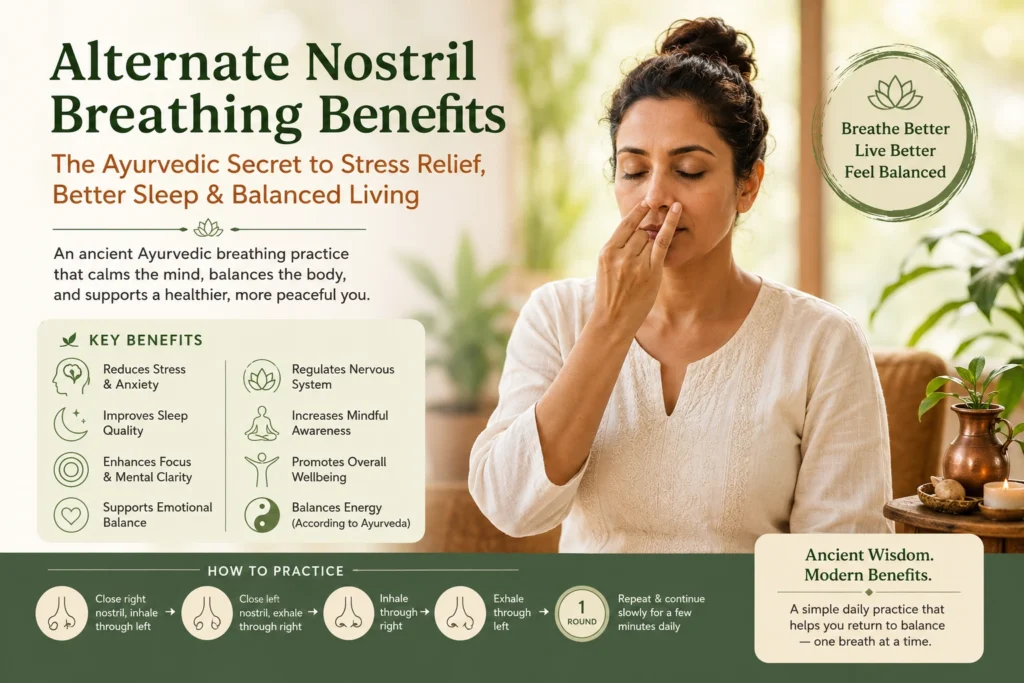
How to Practice Alternate Nostril Breathing
Step-by-Step Beginner Guide
Step 1: Find a Comfortable Position
Sit comfortably.
A chair is perfectly fine.
You do not need a yoga mat.
You do not need special clothing.
Keep your spine comfortably upright.
Step 2: Relax Your Shoulders
Notice where tension is hiding.
Many people carry stress in:
- Jaw
- Neck
- Shoulders
- Upper chest
Allow these areas to soften.
Step 3: Use Your Right Hand
Traditionally:
- Thumb closes right nostril
- Ring finger closes left nostril
Comfort matters more than perfection.
Step 4: Begin the Breathing Pattern
- Close right nostril
- Inhale through left
- Close left nostril
- Exhale through right
- Inhale through right
- Close right nostril
- Exhale through left
This completes one round.
Step 5: Continue Slowly
Practice for:
- 2–3 minutes as a beginner
- 5–10 minutes once comfortable
No force.
No strain.
No rushing.
How Long Should You Practice?
Beginners can start with 2–5 minutes of alternate nostril breathing daily. Many practitioners gradually increase to 5–10 minutes. Consistency is generally more important than duration. A few minutes practiced regularly often produces better results than occasional longer sessions.
What Most Articles Fail to Explain
Many people try alternate nostril breathing once.
Then quit.
Not because it doesn’t work.
Because they expect an immediate transformation.
That’s rarely how sustainable wellness works.
Think of this practice like watering a plant.
One watering helps.
Repeated watering creates growth.
The same principle applies to Stress Management.
What Results Can You Realistically Expect?
The biggest benefit of alternate nostril breathing is often not immediate relaxation. It is gradually becoming less affected by daily stressors over time.
After One Session
Some people notice:
- A calmer feeling
- Less mental noise
- Slower breathing
- Greater awareness
Others notice very little.
Both experiences are normal.
After One Week
With consistent practice many people report:
- Easier relaxation
- Better concentration
- Less emotional reactivity
After One Month
Some people begin noticing:
- Improved stress resilience
- Better sleep habits
- Greater emotional stability
- Increased self-awareness
Common Mistakes Beginners Make
Mistake 1: Breathing Too Forcefully
Many people try to “perform” the technique.
Gentle breathing works better.
Mistake 2: Trying Too Hard to Relax
Ironically, forcing relaxation creates tension.
Allow calmness to emerge naturally.
Mistake 3: Practicing Inconsistently
One session every few weeks is unlikely to create meaningful change.
Small daily practice wins.
Mistake 4: Treating It Like a Quick Fix
Breathwork supports wellness.
It doesn’t eliminate life’s challenges.
Mistake 5: Holding the Breath Too Long
Advanced pranayama techniques sometimes include breath retention.
Beginners should focus on comfortable, natural breathing.
Who Should Try Alternate Nostril Breathing?
This practice may be particularly helpful for people who:
- Feel mentally overwhelmed
- Experience everyday stress
- Have difficulty switching off after work
- Want a gentle introduction to breathwork
- Are interested in Ayurveda
- Want to support Emotional Wellbeing
- Are building healthier daily rituals
Who Should Use Caution?
Consult a qualified healthcare professional if you have:
- Severe respiratory conditions
- Significant cardiovascular conditions
- Medical concerns affecting breathing
If breathing becomes uncomfortable, stop and return to normal breathing.
Myth vs Fact
Myth | Fact |
Alternate nostril breathing is only for yoga practitioners. | It can be practiced by almost anyone. |
You need 30 minutes daily. | Even a few minutes may be beneficial. |
It instantly removes stress. | It helps build resilience over time. |
It is purely spiritual. | It can be approached from wellness, mindfulness, or traditional perspectives. |
More effort equals better results. | Gentle, consistent practice usually works best. |
A Simple 7-Day Stress Relief Challenge
If you’re curious but unsure where to begin:
Day 1–2: Practice 2 minutes.
Day 3–4: Practice 3–4 minutes.
Day 5–6: Practice 5 minutes.
Day 7:Reflect on:
- Did your breathing feel easier?
- Did you react differently to stress?
- Did your mind settle more quickly?
Small observations often reveal meaningful changes.
Reflection Questions
Take a moment and ask yourself:
- When do I feel most stressed during the day?
- How does stress show up in my body?
- Do I notice shallow breathing when overwhelmed?
- What would change if I paused for three minutes before reacting?
These questions often reveal more than any wellness tip.
Alternate Nostril Breathing and the Vedicwibes Wellness Ecosystem
One reason Vedicwibes emphasizes breathwork is that it naturally connects with several core wellness pillars.
Alternate nostril breathing can support:
- Stress Management
- Sleep Wellness
- Emotional Wellbeing
- Mindful Living
- Healthy Aging
- Daily wellness rituals
If stress is affecting sleep, readers may also benefit from natural ways to improve sleep
If emotional overwhelm is a frequent challenge, consider exploring daily stress management habits
For a broader lifestyle approach yoga practices for stress relief can complement breathwork beautifully.
Frequently Asked Questions
Does alternate nostril breathing reduce stress?
It may help reduce feelings of stress by encouraging slower breathing and supporting relaxation.
Is alternate nostril breathing good for anxiety?
Many people use it as a form of breathing for anxiety because it promotes calm, focused breathing patterns.
How often should I practice?
Daily practice is ideal. Even 3–5 minutes can be beneficial.
What is the best time to practice?
Morning and evening are common choices, but any consistent time works.
How quickly does it work?
Some people feel calmer immediately. Long-term benefits generally develop through regular practice.
Can beginners do Nadi Shodhana?
Yes. It is widely considered one of the most beginner-friendly breathing practices.
Can it help with sleep?
Many practitioners find it useful before bedtime because it encourages relaxation.
What are the main Nadi Shodhana benefits?
Potential benefits include reduced stress, improved focus, emotional balance, and support for relaxation.
Should breathing be deep?
Comfortable breathing is more important than extremely deep breathing.
Can I practice every day?
Yes. Daily practice is commonly recommended.
Is alternate nostril breathing part of Ayurveda?
It is strongly associated with traditional yogic and Ayurvedic wellness practices.
Does it improve concentration?
Many practitioners report improved focus and reduced mental distraction.
Can older adults practice it?
Most healthy adults can practice it comfortably. Those with medical concerns should seek professional guidance.
Is alternate nostril breathing meditation?
Not exactly. It is a breathwork practice, though it can complement meditation.
What if one nostril feels blocked?
Practice gently. If breathing feels difficult, wait until nasal passages are more comfortable.
Stress rarely arrives all at once.
It accumulates.
One rushed morning.
One poor night’s sleep.
One difficult week.
Then another.
That’s why sustainable wellness often comes from small daily practices rather than dramatic changes.
The greatest alternate nostril breathing benefits may not be that it makes you feel calm for five minutes.
The deeper benefit is learning how to return to balance more easily when life pulls you away from it.
That is the heart of both Ayurveda and modern wellness.
Not perfection.
Balance.
If you’re new to breathwork, start with two minutes today.
Not next week.
Not when life becomes less busy.
Today.
Because sometimes the most powerful wellness habit begins with a single breath.
About The Author

Ishita Sengupta
Ishita Sengupta is a wellness educator and founder of Vedicwibes. She shares practical Ayurvedic tips and mindful living strategies for people looking to live healthier, balanced lives. Her approach blends ancient wisdom with modern practicality, making wellness simple, effective, and enjoyable.
- Ishita Senguptahttps://vedicwibes.com/author/consultishitahahgmail-com/
 September 28, 2025
 - Ishita Senguptahttps://vedicwibes.com/author/consultishitahahgmail-com/
 September 20, 2025
 - Ishita Senguptahttps://vedicwibes.com/author/consultishitahahgmail-com/
 September 9, 2025
 - Ishita Senguptahttps://vedicwibes.com/author/consultishitahahgmail-com/
 September 3, 2025